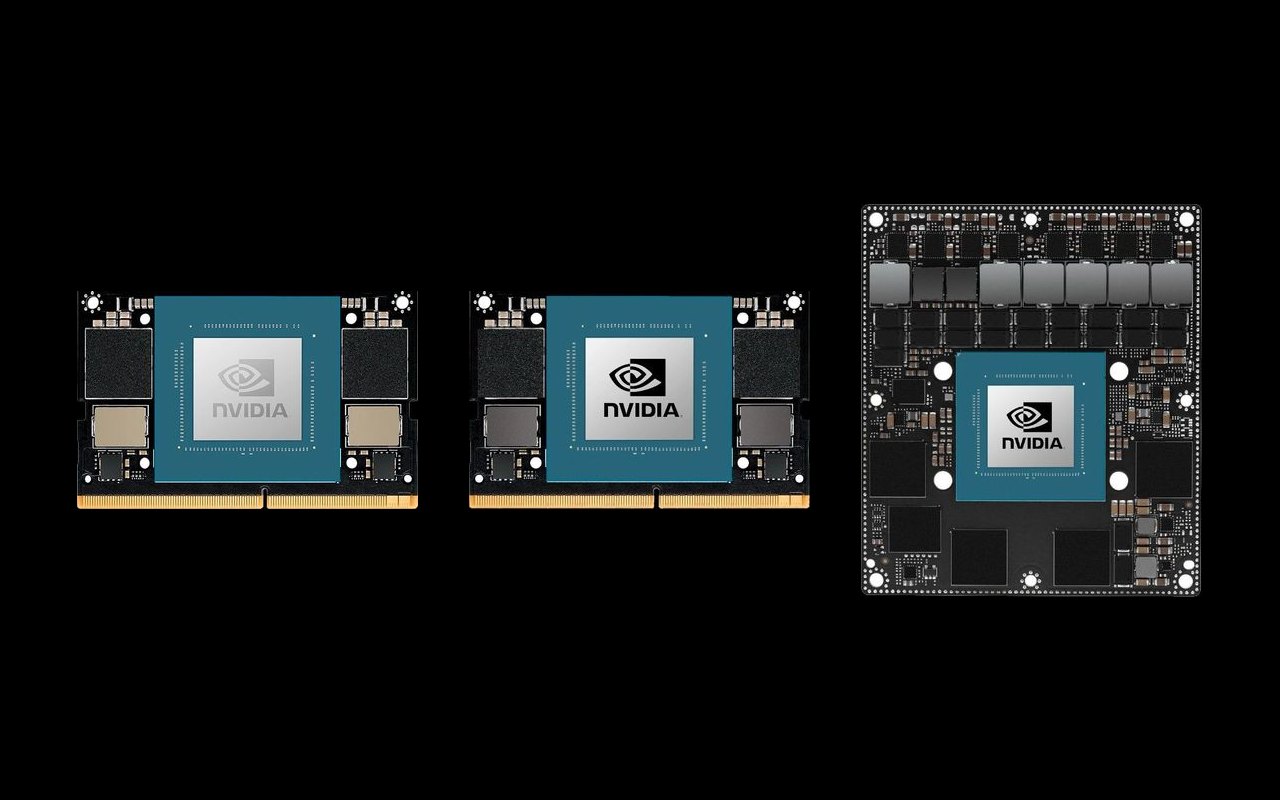
The NVIDIA Jetson Orin family offers a range of System-on-Module (SoM) options that share the same software stack but differ dramatically in AI performance, memory, and power consumption. Choosing the right module at the start of your project can save months of re-engineering later.
In this guide, we compare every current Jetson Orin module, from the 34 TOPS Orin Nano 4GB to the 275 TOPS AGX Orin 64GB, to help you match the right hardware to your edge AI application.
The Complete Jetson Orin Lineup
| Module | AI Performance | GPU | CPU | Memory | Power |
|---|---|---|---|---|---|
| Orin Nano 4GB | 34 TOPS | 512 CUDA | 6-core A78AE | 4GB LPDDR5 | 7–25W |
| Orin Nano 8GB | 67 TOPS | 1024 CUDA* | 6-core A78AE | 8GB LPDDR5 | 7–25W |
| Orin NX 8GB | 117 TOPS | 1024 CUDA | 6-core A78AE | 8GB LPDDR5 | 10–40W |
| Orin NX 16GB | 157 TOPS | 1024 CUDA | 8-core A78AE | 16GB LPDDR5 | 10–40W |
| AGX Orin 32GB | 200 TOPS | 1792 CUDA | 8-core A78AE | 32GB LPDDR5 | 15–75W |
| AGX Orin 64GB | 275 TOPS | 2048 CUDA | 12-core A78AE | 64GB LPDDR5 | 15–60W |
*Orin Nano 8GB with Super software update
Understanding the Tiers
Orin Nano: The Accessible Entry Point (34–67 TOPS)
The Orin Nano modules are designed for cost-sensitive, compact edge AI products. With the Super software update, the 8GB variant now delivers 67 TOPS, enough to run generative AI models like Llama 3.1 8B locally.
Best for: Smart cameras, IoT gateways, entry-level robotics, prototyping, and educational AI projects. If your model runs comfortably within 8GB of memory and your power budget is under 25W, the Orin Nano is the most cost-effective choice.
Orin NX: The Compact Powerhouse (117–157 TOPS)
The Orin NX doubles the AI performance of the Orin Nano while sharing the same compact SO-DIMM form factor. The 16GB variant adds 8-core CPU and 16GB memory, a significant step up for multi-model or multi-stream workloads.
Best for: Autonomous mobile robots (AMRs), multi-camera video analytics, industrial quality inspection, and drones. If you need to run 2-4 AI models simultaneously or process multiple camera feeds, the Orin NX provides the headroom the Orin Nano lacks.
AGX Orin: Maximum Edge AI Performance (200–275 TOPS)
The AGX Orin modules are the performance flagships of the Orin family. With up to 2048 CUDA cores, 64GB of memory, and 275 TOPS, they handle workloads that would otherwise require cloud offloading.
Best for: Advanced autonomous vehicles, surgical robotics, multi-sensor fusion with LiDAR/radar/camera, digital twin inference at the edge, and any application where latency cannot tolerate a network round-trip.
Decision Framework
Ask yourself these questions:
- How many AI models run simultaneously? One model → Orin Nano. 2-4 models → Orin NX. 5+ models or large multi-modal → AGX Orin.
- What's your power budget? Under 25W → Orin Nano. Under 40W → Orin NX. Under 60W → AGX Orin.
- How much memory does your model need? Under 4GB → Orin Nano 4GB. Under 8GB → Orin Nano 8GB or NX 8GB. Under 16GB → Orin NX 16GB. More → AGX Orin.
- Are you going to production or prototyping? For prototyping, start with the AGX Orin Developer Kit, it can emulate any lower-tier module via software configuration.
Form Factor Compatibility
A critical design consideration: the Orin Nano and Orin NX modules share the same 260-pin SO-DIMM connector. This means you can design a single carrier board that supports all four modules, enabling product line tiering from a single hardware design.
The AGX Orin uses a different 699-pin Molex connector and is pin-compatible with the Jetson AGX Xavier, enabling upgrades for existing Xavier deployments.
The Bottom Line
The Jetson Orin family's shared software stack (JetPack SDK, CUDA, TensorRT) means your AI models and applications port seamlessly across all modules. Start development on the module that matches your target deployment, or use the AGX Orin Developer Kit to emulate any module during prototyping.
Need help selecting the right Jetson module for your project? Contact us for personalized guidance based on your AI model, power constraints, and deployment scale.