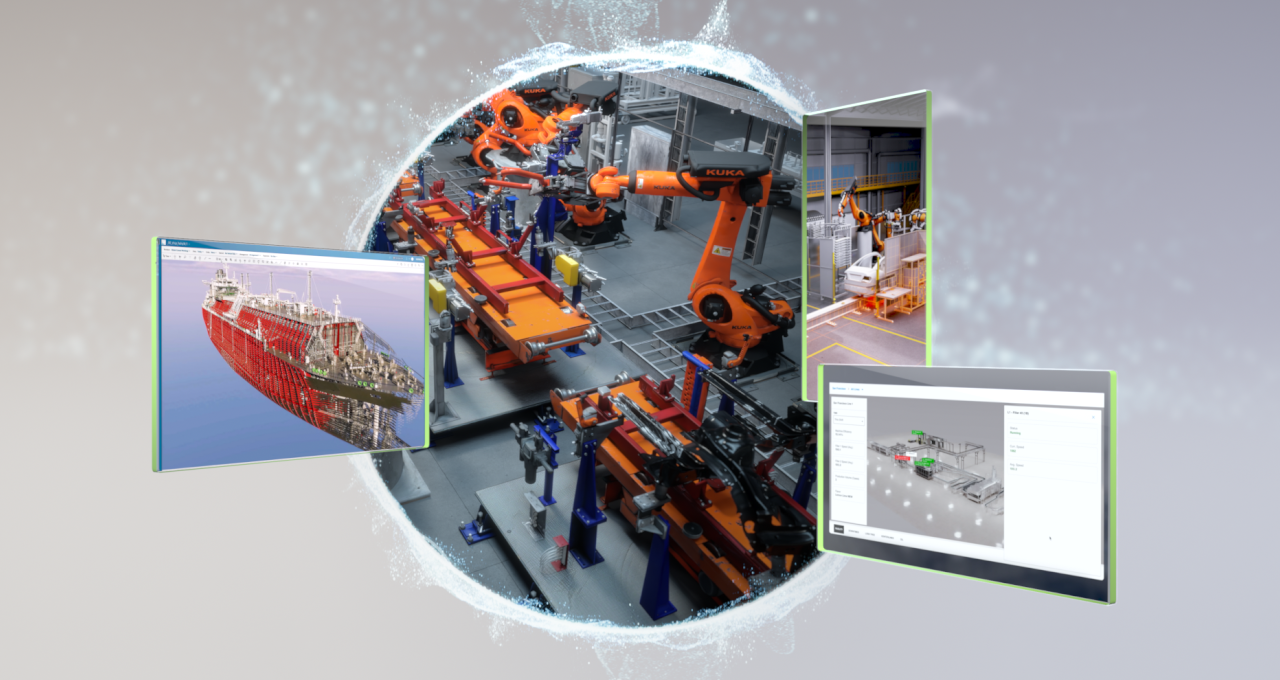
The phrase "digital twin" gets used loosely. NVIDIA Omniverse gives it a concrete technical definition: a live, physically accurate, simulation-ready 3D representation of a real-world asset, built on the open standard OpenUSD. Here's what that actually means in practice.
OpenUSD: The Foundation
OpenUSD (Universal Scene Description) is an open standard originally developed by Pixar to share 3D scenes between artists and tools. Omniverse adopts USD as the substrate for industrial work, and NVIDIA has invested heavily in the OpenUSD project itself, performance, schema extensions, and tooling.
Why USD matters: it is the first widely-adopted format that handles composition (combining many sub-scenes into one), variants (multiple configurations of the same asset), and layers (non-destructive overrides). Industrial scenes are huge and constantly changing, USD is built for that.
What Omniverse Adds
Omniverse is a platform of APIs, SDKs, and services around USD:
- RTX rendering for real-time, path-traced visualization at production fidelity
- Connectors that link Maya, 3ds Max, Revit, Creo, SolidWorks, Unreal, Unity, Houdini, Blender to a live USD scene
- PhysX for rigid-body and articulated-body physics
- Warp for differentiable simulation in Python
- Sensor simulation for cameras, LiDAR, radar, ultrasonics
- Omniverse Cloud APIs for streaming and embedding twins into web apps
The Industrial Pattern
An industrial digital twin in Omniverse typically looks like this:
- Source geometry from CAD (Creo, SolidWorks, Catia)
- Plant layout from BIM (Revit) and survey scans
- Live data from PLCs, sensors, and MES systems streamed in via OPC UA or MQTT
- Simulation overlays, robotics, fluid flow, thermal, traffic, driven by NVIDIA Modulus and PhysX
- Visualization via RTX rendering, streamed to engineers and operators on any device
Real Use Cases
Factory Digital Twins
Manufacturers like BMW, Siemens, and Foxconn use Omniverse to design new lines virtually, simulate throughput, and train robotics policies in synthetic data before touching the real factory. The economic case is the avoided cost of physical iteration cycles.
Warehouse and Logistics
Operators of large warehouses use Omniverse twins to optimize layout and to train autonomous mobile robots in simulation. NVIDIA Isaac Sim, built on Omniverse, is the reference platform for robotics simulation.
AEC (Architecture, Engineering, Construction)
Design review collapses from week-long cycles into live multi-stakeholder sessions when everyone sees the same RTX-rendered USD scene. Disciplines stay in their native tools while edits flow through USD.
Autonomous Vehicles
NVIDIA DRIVE Sim uses Omniverse to generate vast amounts of synthetic driving data for training perception models, including edge cases that would be unsafe to capture in the real world.
The Hardware
Omniverse is RTX-bound. The recommended GPUs are:
- RTX PRO 6000 Blackwell for high-end workstations
- RTX 6000 Ada for current-generation workstations
- L40S for cluster-side rendering and Omniverse Cloud
For multi-user team deployments, an Omniverse Nucleus server provides shared scene hosting; for cloud-streamed twins, Omniverse Cloud microservices on Azure or AWS handle the rendering tier.
Adoption Path
The realistic adoption path:
- Start with one engineering use case (factory line, warehouse, building)
- Connect existing CAD/BIM tools via Omniverse connectors, no rip-and-replace
- Build the first USD scene with live data feeds
- Add simulation incrementally, physics, robotics, sensor
- Expose the twin to operations via streaming clients
Why OpenUSD, Not a Proprietary Format
Industrial twins are multi-decade assets. Betting on a closed format is a long-term liability. OpenUSD is genuinely open, supported by Apple, Adobe, Autodesk, Pixar, Foundry, and others. The platform risk profile is dramatically better than any single-vendor format.
Considering Omniverse for an industrial digital twin? Browse our NVIDIA Omniverse Enterprise product page or contact our team for a phased deployment plan.