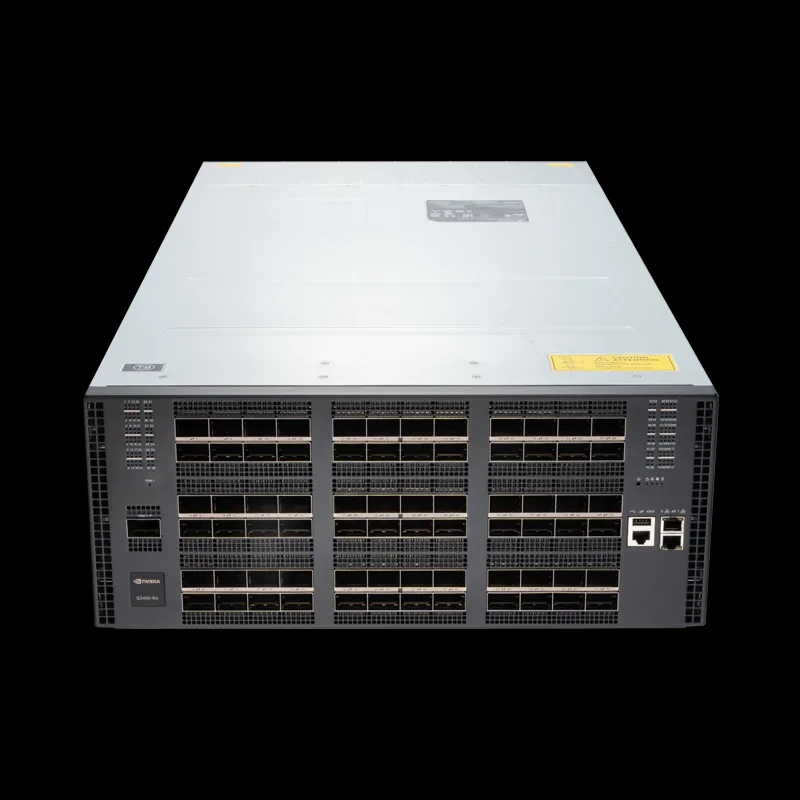
Scale-out networking is the part of the AI factory that nobody notices until it breaks. NVIDIA Quantum-X800 is the latest generation of NVIDIA's InfiniBand platform, delivering 800 Gb/s end-to-end bandwidth from switch to SuperNIC. In this article we walk through what changed, what stayed the same, and how Quantum-X800 fits with Rubin and Blackwell deployments.
What Quantum-X800 Includes
Quantum-X800 is a platform, not just a switch. It includes:
- Quantum Q3400 switch: 144 ports of 800 Gb/s InfiniBand, 115.2 Tb/s aggregate
- ConnectX-8 SuperNIC as the matched endpoint NIC
- SHARPv4 for in-network reductions
- NVIDIA UFM for fabric management
- Optical and copper cabling qualified for the platform
What Changed from Quantum-2
Quantum-2 ran at 400 Gb/s NDR. Quantum-X800 doubles that to 800 Gb/s XDR per port, with 5x higher aggregate switch bandwidth. The headline gains are:
- 5x bandwidth per port and per switch
- 9x in-network compute capability via SHARPv4
- 2x port radix per fixed switch unit (144 vs 64 ports)
For AI training, the most interesting upgrade is SHARPv4. Collective operations (all-reduce, all-gather) now run inside the switch fabric itself, freeing GPU cycles and reducing collective latency.
SHARPv4 in Practice
SHARP, Scalable Hierarchical Aggregation and Reduction Protocol, moves the actual reduction math into switch silicon. SHARPv4 expands the supported precisions (FP8, BF16, FP32, NVFP4) and the supported topologies. For a large training job, SHARPv4 can shave 20–30% off all-reduce time, which translates directly into shorter training cycles.
Topology Choices
For AI factories two topologies dominate:
- Fat-tree for general-purpose scale-out, easy to reason about, well-understood
- DragonFly+ for largest-scale deployments, lower switch count at scale, more complex routing
Quantum-X800 supports both. The decision usually comes down to scale: under ~10,000 GPUs, fat-tree is simpler; above that, DragonFly+ saves real money on switches.
Quantum-X800 vs Spectrum-X
NVIDIA offers two scale-out fabrics: Quantum-X800 (InfiniBand) and Spectrum-X (Ethernet). The choice depends on:
- InfiniBand wins on raw throughput, lowest latency, mature collectives, and HPC heritage. The right choice for tightly-coupled training and HPC.
- Ethernet wins on operational familiarity, vendor diversity, and cost predictability. The right choice for multi-tenant AI clouds.
Operational Considerations
Practical things to plan for when deploying Quantum-X800:
- Optics: 800 Gb/s typically means 8x100G optical lanes; verify SR/DR/LR availability and DDM accuracy
- Cabling distance: Active optical cables (AOC) and DAC ranges differ, plan rack layouts accordingly
- UFM deployment: Provision a UFM appliance pair for HA management
- Subnet manager: Decide between hardware SM (in switch) and software SM (in UFM)
When to Adopt
Quantum-X800 is the default scale-out fabric for new Rubin deployments. For Blackwell GB300 NVL72 deployments it is also the recommended pairing. If you operate Quantum-2 NDR today, you can mix-and-match, but a forklift to Quantum-X800 typically pays back inside one training cycle for capacity-constrained workloads.
Designing or upgrading a scale-out fabric? Browse our NVIDIA Quantum-X800 InfiniBand product page or contact our team for a fabric architecture review.