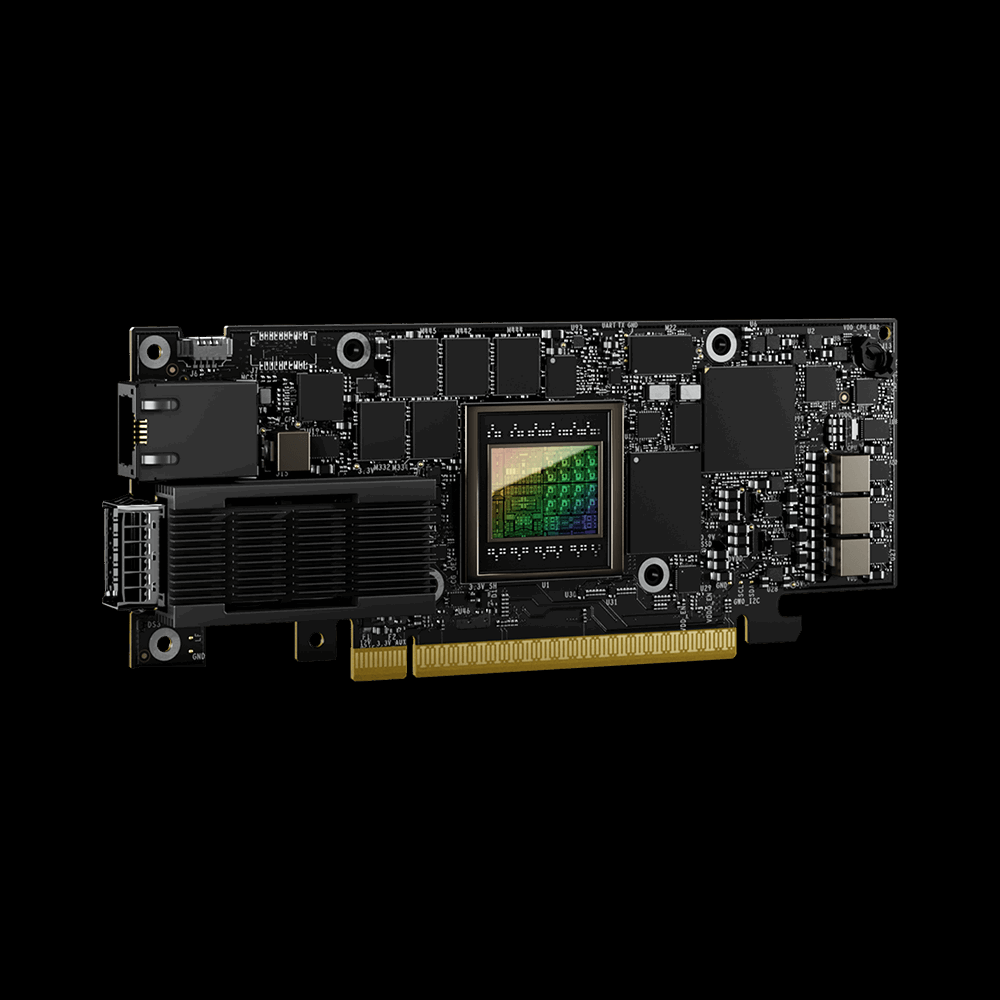
The CPU runs your application. The GPU runs your model. The DPU runs the infrastructure, networking, security, storage, and frees the CPU to do useful work. NVIDIA BlueField-3 is the current generation of NVIDIA's DPU line, and in 2026 it is the quiet engine inside most large AI deployments.
What a DPU Does
A DPU is a programmable infrastructure computer on a NIC. Instead of bouncing every packet through the host CPU's network stack, the DPU terminates the network, runs services in its own ARM cores, and presents virtualized resources to the host. Practical impact:
- CPU cores freed from networking and storage overhead, sometimes 20–30% per node
- Hardware isolation between tenant workloads and infrastructure code
- Programmable acceleration for crypto, telemetry, and policy enforcement
BlueField-3 Architecture
| Component | Specification |
|---|---|
| Arm Cores | 16 x Cortex-A78 |
| DDR Memory | 32 GB DDR5 |
| Network | 400 Gb/s Ethernet or InfiniBand |
| Host Interface | PCIe Gen 5 x16 |
| Crypto | Hardware AES, TLS, IPsec offload |
| Storage | NVMe-oF emulation, GPUDirect Storage |
| Security | Hardware root of trust, secure boot |
The DOCA Stack
NVIDIA DOCA (Data Center Infrastructure on a Chip Architecture) is the SDK for BlueField. DOCA provides:
- DOCA Flow: Programmable packet processing
- DOCA Comm Channel: Host-DPU communication
- DOCA Telemetry: Per-flow visibility
- DOCA App Shield: Security and microsegmentation
- DOCA Storage: NVMe-oF and SNAP emulation
The DOCA model is similar to CUDA: NVIDIA-supplied libraries on a programmable substrate, with the option to drop down to lower-level APIs when you need them.
Production Use Cases
1. Multi-Tenant AI Cloud Isolation
BlueField runs the cloud control plane (Open vSwitch, Kubernetes CNI, security policies) in its own ARM cores. Tenant workloads run on the host CPU and GPUs, with no path into the infrastructure plane. Hyperscalers use this pattern to isolate untrusted tenants from each other and from the host.
2. Storage Acceleration
BlueField terminates NVMe-oF connections to remote storage and presents local-looking NVMe namespaces to the host. Combined with GPUDirect Storage, data flows directly from network to GPU memory without host CPU involvement.
3. Zero-Trust Networking
BlueField enforces microsegmentation between workloads on the same host. Traffic that traditionally would have looped through the host kernel now terminates on the DPU, where policy is applied independent of the host OS.
4. East-West Service Mesh Offload
For Kubernetes deployments, BlueField can offload sidecar proxy duties (Envoy, Linkerd) to the DPU. Pods get the same service mesh semantics with substantially less per-node CPU overhead.
BlueField-3 in Spectrum-X
BlueField-3 is the SuperNIC inside Spectrum-X. It implements adaptive routing at the endpoint, executes Direct Data Placement, and runs the congestion control loop that delivers AI-class Ethernet performance. Without BlueField-3, Spectrum-X is just fast Ethernet.
BlueField-3 vs BlueField-4
BlueField-4, announced as part of the Rubin platform, doubles bandwidth and adds Arm cores. For deployments going live in 2026 H1 or earlier, BlueField-3 is the right choice today. Plan a multi-year refresh path to BlueField-4 as Rubin lands.
Buying Considerations
- Form factor: OCP 3.0 NIC vs PCIe HHHL, match to chassis
- Software: DOCA versions are tied to BlueField OS releases; align refresh windows
- Operator skills: DPU operations are a new discipline; budget training time for SREs
- Integration: Validate with your hypervisor / Kubernetes distribution
Considering DPUs for your AI cloud? Browse our NVIDIA BlueField-3 DPU product page or contact our team for a deployment plan that maps DOCA capabilities to your operational requirements.