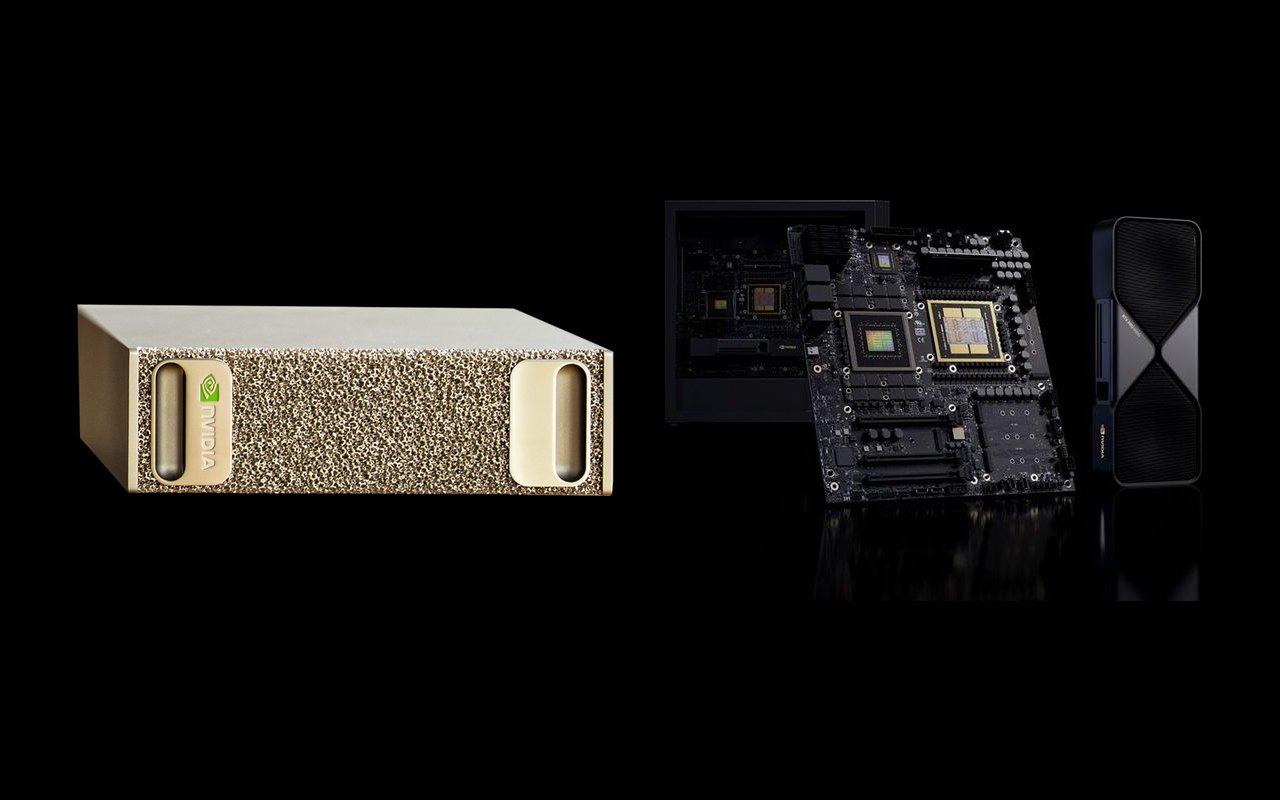
NVIDIA's personal AI supercomputer lineup gives individuals and small teams the power to develop, train, and run AI models locally, without cloud dependencies. But the DGX Spark and DGX Station serve very different needs at very different price points.
In this guide, we break down the critical differences to help you choose the right system for your AI development workflow.
Specifications Comparison
| Specification | DGX Spark | DGX Station |
|---|---|---|
| Processor | GB10 Grace Blackwell | GB300 Grace Blackwell Ultra |
| AI Performance | 1 PFLOPS | 20 PFLOPS |
| Memory | 128 GB LPDDR5x unified | 748 GB coherent (252 HBM3e + 496 LPDDR5X) |
| Memory Bandwidth | 273 GB/s | 7.1 TB/s (GPU) + 396 GB/s (CPU) |
| CPU | 20-core Arm | 72-core Grace Neoverse V2 |
| Max Model Size | ~200B params (inference), ~70B (fine-tuning) | ~1T params |
| Networking | ConnectX-7 200GbE, Wi-Fi 7 | ConnectX-8 800GbE |
| Power | 240W | 1,600W |
| Form Factor | 150 × 150 × 50 mm (1.2 kg) | Desktop tower |
| MIG Support | No | Up to 7 instances |
DGX Spark: AI Development for Everyone
The DGX Spark is a personal AI development device that fits on your desk, literally. At 150mm × 150mm and 1.2kg, it's smaller than most Wi-Fi routers. But inside, the GB10 Grace Blackwell Superchip delivers 1 PFLOPS of AI performance with 128GB of unified memory.
This means you can run inference on models with up to 200 billion parameters and fine-tune models up to 70 billion parameters, entirely locally, with zero cloud cost and full data privacy.
Ideal user: Individual AI developers, data scientists, researchers, and students who need a powerful local AI development environment without dedicating an entire room to hardware.
DGX Station: A Data Center on Your Desk
The DGX Station is in a completely different league. With the GB300 Grace Blackwell Ultra Desktop Superchip delivering 20 PFLOPS and 748GB of coherent memory, it handles models up to 1 trillion parameters. It also supports Multi-Instance GPU (MIG) for up to 7 isolated instances, making it a multi-user AI development platform.
Ideal user: AI research labs, enterprise development teams, and organizations that need to train and fine-tune the largest models without data center infrastructure.
The Decision Framework
Choose DGX Spark if:
- You're an individual developer or small team
- Your models are under 200B parameters for inference
- You want a quiet, compact device that sits on your desk
- 240W power consumption fits your environment
- Wi-Fi 7 connectivity is valuable for your setup
- Budget favors a more accessible entry point
Choose DGX Station if:
- You work with models approaching or exceeding 1 trillion parameters
- Multiple team members need simultaneous GPU access (MIG)
- You need HBM3e memory bandwidth (7.1 TB/s) for training workloads
- 800GbE networking is needed for multi-node scaling
- Your organization can accommodate 1,600W power and cooling
Can They Work Together?
Yes. A practical deployment pattern is DGX Spark for each developer's desk (local prototyping and inference) with a shared DGX Station for team training runs. Developers prototype locally on DGX Spark, then submit larger training jobs to the DGX Station, maximizing both individual productivity and shared compute utilization.
The Bottom Line
The DGX Spark democratizes AI development, every developer can have a personal AI supercomputer for the cost of a high-end laptop. The DGX Station is for organizations that need data center-class AI compute without building a data center. They're not competitors; they're complementary tools for different scales of AI work.
Ready to bring AI development in-house? Contact us for DGX Spark and DGX Station pricing, team deployment planning, and configuration support.