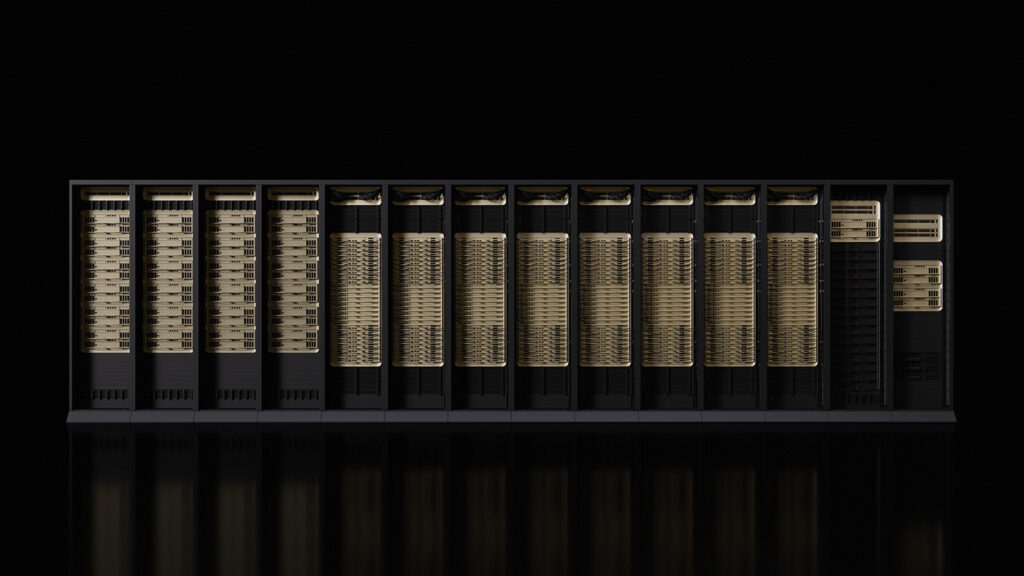
If you already operate Blackwell GB300 NVL72 racks, or you are mid-procurement on Blackwell, the launch of Vera Rubin NVL72 raises an obvious question: upgrade now, wait, or run them side by side? This buyer’s guide compares the two rack-scale platforms across every dimension that matters and gives clear guidance on when each makes sense.
Headline Comparison
| Specification | GB300 NVL72 (Blackwell Ultra) | Vera Rubin NVL72 |
|---|---|---|
| GPUs | 72 x B300 | 72 x Rubin |
| CPUs | 36 x Grace | 36 x Vera (Olympus) |
| HBM Generation | HBM3e | HBM4 |
| HBM Capacity / GPU | up to 288 GB | up to 288 GB |
| HBM Bandwidth / GPU | ~8 TB/s | 22 TB/s |
| Aggregate HBM BW | ~576 TB/s | 1.6 PB/s |
| NVLink Generation | NVLink 5 | NVLink 6 |
| Scale-Up Bandwidth | ~130 TB/s | 260 TB/s |
| NVFP4 Inference | ~720 PFLOPS | 3.6 EFLOPS |
| Networking SuperNIC | ConnectX-8 | ConnectX-9 |
| Networking DPU | BlueField-3 | BlueField-4 |
Where the Gap Is Largest
Three areas show step-function differences:
1. Memory Bandwidth
HBM4’s 22 TB/s per GPU vs HBM3e’s 8 TB/s is more than 2.5x. Memory-bound workloads, large-context inference, sparse expert routing in MoE, long-sequence attention, see the largest swings.
2. Scale-Up Fabric
NVLink 6 doubles per-GPU bandwidth and brings rack-level scale-up to 260 TB/s. For tensor-parallel inference of trillion-parameter models, this is often the binding constraint.
3. Disaggregated Inference (Rubin CPX)
Adding Rubin CPX nodes to a Vera Rubin rack changes inference economics for long-context workloads. Blackwell has no equivalent.
Where Blackwell Stays Competitive
GB300 NVL72 is not obsolete. It remains the right choice when:
- Your facility is already provisioned and live on Blackwell, finish your buildout
- Your workloads are compute-bound rather than memory-bound
- You need volume capacity in 2026 H1 (Rubin partner availability is H2)
- Your software stack benefits from Blackwell’s mature, in-the-field debug history
Power, Cooling, Footprint
Both racks are liquid-cooled and demand 100+ kW per rack. Rubin’s higher density pushes thermal engineering harder. If your facility supported GB300 NVL72, Rubin will mostly fit, but verify CDU capacity, leak detection coverage, and water chemistry.
Procurement Reality
Rubin partner availability begins H2 2026. Hyperscalers (AWS, Azure, GCP, OCI) get first allocation. For enterprise procurement timelines this typically means contracted delivery dates in late 2026 to early 2027. If you need capacity online sooner, Blackwell is the rational choice today.
Decision Framework
Use this matrix:
- New AI factory, 2027 go-live → Rubin NVL72. Design power, cooling, and fabric for Rubin from the start.
- Existing Blackwell deployment, scaling out → mostly Blackwell with Rubin pods. Run them side by side; partition workloads.
- Workload dominated by long-context inference → wait for Rubin + CPX. The TCO swing is too large to ignore.
- Capacity needed in next 6 months → Blackwell GB300. Don’t stall projects for an architecture that’s not yet shipping in volume.
Migration Strategy
Plan for a multi-year coexistence. Most large operators will run mixed Blackwell and Rubin fleets through 2027–2028. The keys are:
- Workload-aware scheduling (Slurm, Kubernetes) that targets the right architecture
- Consistent observability across generations (NVIDIA NetQ, DCGM)
- Unified scale-out fabric (Quantum-X800 or Spectrum-X) that spans both
Need help building the right mix? We size, source, and integrate both Blackwell and Rubin systems. Browse our Vera Rubin NVL72 and DGX GB300 NVL72 product pages or contact our team for a procurement plan tailored to your timeline.