NVIDIA DGX Spark: Personal AI Supercomputer Features
Building and running today’s generative AI models on a typical workstation is increasingly difficult. Model sizes are growing, memory requirements keep climbing, and iteration speed matters more than ever for teams trying to prototype, fine-tune, and deploy quickly. NVIDIA DGX Spark is designed for this new reality: a compact personal AI computer built from the ground up to develop and run AI locally—without giving up the software experience and scalability that enterprises expect.
What Is NVIDIA DGX Spark?
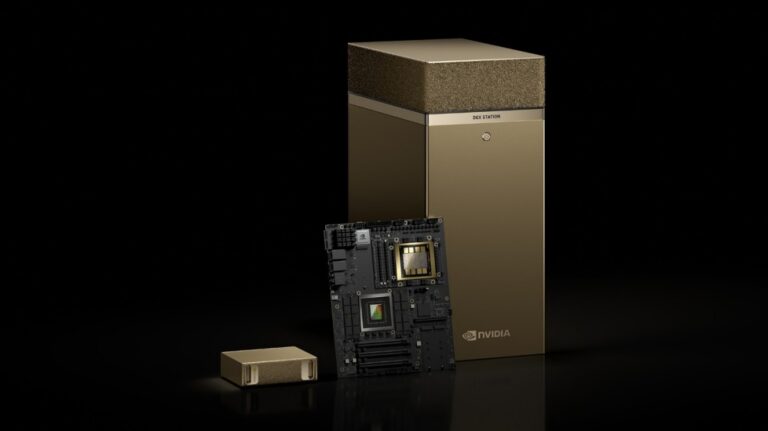
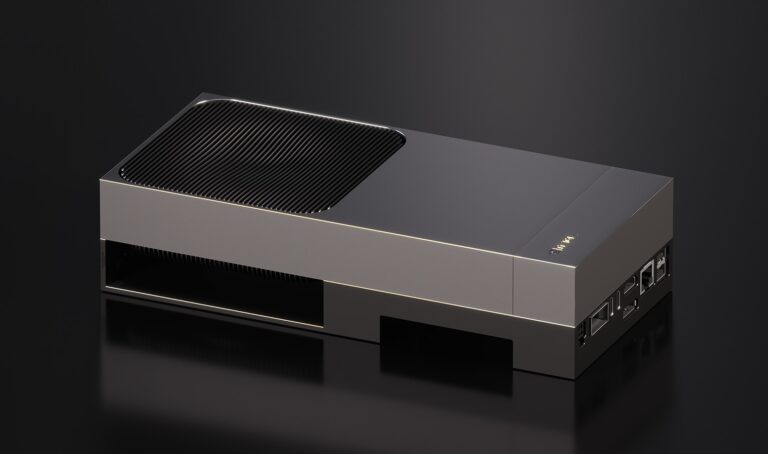
NVIDIA DGX Spark is a desktop AI system powered by the NVIDIA GB10 Grace Blackwell Superchip. It delivers up to 1 petaFLOP of AI performance (FP4) in a power-efficient, compact form factor, while providing 128 GB of coherent unified system memory and a preinstalled NVIDIA AI software stack. The result is a machine purpose-built for modern AI workflows—especially prototyping, fine-tuning, and inference of large language models (LLMs) and reasoning models.
Why Desktop AI Compute Is Suddenly So Demanding
Generative AI development used to be possible on a high-end GPU workstation for many projects. But as model sizes and complexity have surged, local development has become challenging. Fine-tuning and inference for large models can require:
- Large memory capacity to load model weights and run multiple processes.
- High compute throughput to iterate quickly on prompts, training parameters, and evaluation.
- Efficient data preprocessing so the GPU isn’t idling.
As enterprises, startups, government agencies, and researchers expand AI efforts, access to reliable compute resources becomes a bottleneck. DGX Spark addresses this by creating an “AI experimentation ground” at the desktop—helping teams prototype locally and reserve cluster resources for large-scale training and production deployment.
Key Features and Advantages of NVIDIA DGX Spark
1) Powered by the NVIDIA GB10 Grace Blackwell Superchip
At the core of DGX Spark is the NVIDIA GB10 built on the NVIDIA Grace Blackwell architecture. This superchip pairs:
- A NVIDIA Blackwell GPU with fifth-generation Tensor Cores and FP4 support.
- A NVIDIA Grace CPU with a 20-core high-performance Arm architecture (10 Cortex-X925 + 10 Cortex-A725).
This combination is designed to accelerate not only model inference and tuning, but also the surrounding tasks—like data preprocessing and orchestration—that determine how fast you can iterate.
2) Up to 1 petaFLOP of FP4 AI Performance
DGX Spark delivers up to 1 PFLOP of AI performance at FP4 precision. For many generative AI workloads, this enables more responsive local experimentation and faster iteration cycles. Whether you’re testing retrieval-augmented generation (RAG), evaluating prompts, or validating fine-tuning runs, performance translates directly into productivity.
3) 128 GB of Coherent Unified System Memory
One of DGX Spark’s most practical advantages for local AI development is its 128 GB LPDDR5x coherent unified system memory. This unified memory model supports large model development and testing workflows on a single desktop machine—helping reduce friction that typically arises when models or contexts push beyond conventional memory limits.
With this memory capacity, DGX Spark supports AI models up to 200 billion parameters locally, making it suitable for advanced prototyping, fine-tuning, and inference on large-parameter models.
4) Scale Up with NVIDIA ConnectX Networking (Up to 405B Parameters with Two Systems)
DGX Spark includes NVIDIA ConnectX networking, enabling high-performance connectivity between systems. Notably, you can link two DGX Spark systems to work with models up to 405 billion parameters—useful for experimenting with extremely large models such as Llama 3.1 405B class workloads.
From a practical standpoint, this offers a path to expand capacity without immediately moving into a full data center environment.
5) AI-Ready Software Stack and Familiar Developer Tools
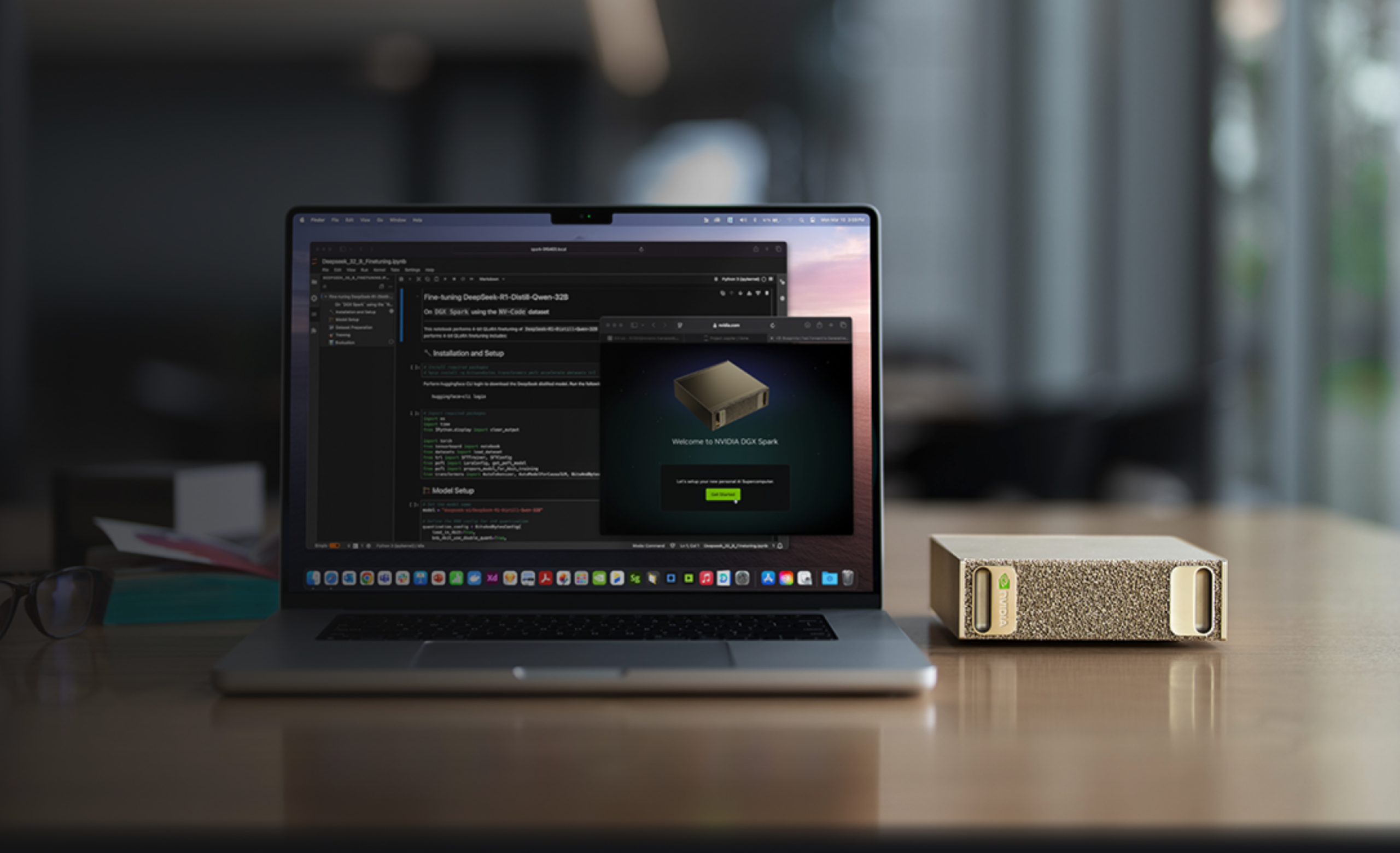
Hardware matters, but AI productivity depends on software. DGX Spark mirrors the software architecture used in industrial-strength AI factories. It runs NVIDIA DGX OS (with Ubuntu Linux) and comes preconfigured with the latest NVIDIA AI software stack.
This includes a full-stack environment for generative AI workloads—tools, frameworks, libraries, and pretrained model capabilities such as NVIDIA NIM. Developers can also work with familiar tools such as:
- PyTorch
- Jupyter
- Ollama
The benefit is straightforward: you can prototype locally and then move work to DGX Cloud or other accelerated cloud/data center infrastructure with less rework.
NVIDIA DGX Spark Specifications (Highlights)
Below are some key specs that define DGX Spark as a purpose-built desktop AI system:
- Architecture: NVIDIA Grace Blackwell
- GPU: Blackwell Architecture (5th Gen Tensor Cores; 4th Gen RT Cores)
- CPU: 20-core Arm (10 Cortex-X925 + 10 Cortex-A725)
- AI Performance: Up to 1 PFLOP (FP4)
- System Memory: 128 GB LPDDR5x coherent unified memory
- Memory Bandwidth: 273 GB/s
- Storage: 4 TB NVMe M.2 with self-encryption
- Networking: ConnectX-7 NIC @ 200 Gbps, plus 10 GbE RJ-45
- Wireless: Wi-Fi 7, Bluetooth 5.4
- Power: 240 W PSU; GB10 TDP 140 W
- Size/Weight: 150 mm x 150 mm x 50.5 mm; 1.2 kg
DGX Spark’s compact footprint makes it realistic to deploy on a desk, in a lab, or across a team—without building out a server room.
Develop Locally, Deploy Anywhere at Scale
A major strategic advantage of DGX Spark is how it fits into an end-to-end AI workflow. Many teams want local iteration for speed, privacy, and convenience, while still needing to scale later for production training or deployment. DGX Spark is designed for that handoff.
By aligning with the NVIDIA AI platform software architecture, work done on DGX Spark can be transitioned to larger environments such as:
- NVIDIA DGX Cloud
- Accelerated enterprise data center infrastructure
- Accelerated cloud platforms
This makes DGX Spark a strong fit for organizations that want to reduce time-to-first-results locally while keeping a clear path to scale.
Who Is NVIDIA DGX Spark For?
DGX Spark is designed to help a wide range of AI builders push projects forward without waiting for shared cluster resources.
- AI developers prototyping and iterating on LLM and reasoning model pipelines
- Data scientists running local inference, evaluation, and fine-tuning experiments
- Researchers needing repeatable, dedicated compute for model testing
- Students and educators seeking hands-on experience with modern AI tooling
- Startups optimizing burn by reserving expensive cluster time for critical training runs
FAQ: NVIDIA DGX Spark
How large of an AI model can DGX Spark run locally?
With 128 GB of unified system memory and FP4 support, DGX Spark supports models up to 200 billion parameters locally for prototyping, fine-tuning, and inference (model support depends on implementation and workflow).
Can DGX Spark handle even larger models?
Yes. Using NVIDIA ConnectX networking, you can connect two DGX Spark systems to work with models up to 405 billion parameters.
What software comes with DGX Spark?
DGX Spark runs NVIDIA DGX OS (Ubuntu-based) and comes preconfigured with the NVIDIA AI software stack, supporting popular developer tools and frameworks and including capabilities such as NVIDIA NIM.
Conclusion
NVIDIA DGX Spark brings serious AI compute to a desktop form factor: up to 1 PFLOP FP4 performance, 128 GB coherent unified memory, support for 200B-parameter models locally, and the ability to link two systems for up to 405B parameters. Combined with the preinstalled NVIDIA AI software stack and a workflow designed to move from local prototyping to cloud or data center scale, DGX Spark is positioned as a practical, high-performance personal AI computer for modern generative AI development.